Showing posts with label Class Projects. Show all posts
Thursday, September 19, 2013
jeNGK: C BLOCK BOOK ARTS AND LETTERPRESS
The initial assignment for the final was an individual project, but we created a new project proposal to work together as a class, which Aaron approved. Each student came up with a two-word phrase on the theme of "junk" and gave it to a classmate to interpret. Those words were turned in to a four-page folio design which we worked in teams to print.
The book is pictured along with our other projects during our class opening on August 2nd.
The initial assignment for the final was an individual project, but we created a new project proposal to work together as a class, which Aaron approved. Each student came up with a two-word phrase on the theme of "junk" and gave it to a classmate to interpret. Those words were turned in to a four-page folio design which we worked in teams to print.
We worked together on nearly every aspect of the final project and the outcome is a true, nine-person collaboration (with lots of help from Taryn Wiens and Aaron Cohick of course!)
Group projects are not always exciting and successful, but this experience was an exception. Each member of the class has a distinct design style, which allowed the final to be a coherent and differentiated piece reflective of each student's efforts.
We worked hard, and had a wonderful time.
All photos and text by Leeds Mallinckrodt-Reese.
Labels:
Class Projects,
Leeds Mallinckrodt-Reese
Thursday, January 19, 2012
TITLE, A METABOOK
Title
A meta/historical book produced by
the History & Future of the Book class during half-block of 2012
12 pages, soft cover, pamphlet stitch
Letterpress printed from handset lead and wood type
Edition of 100
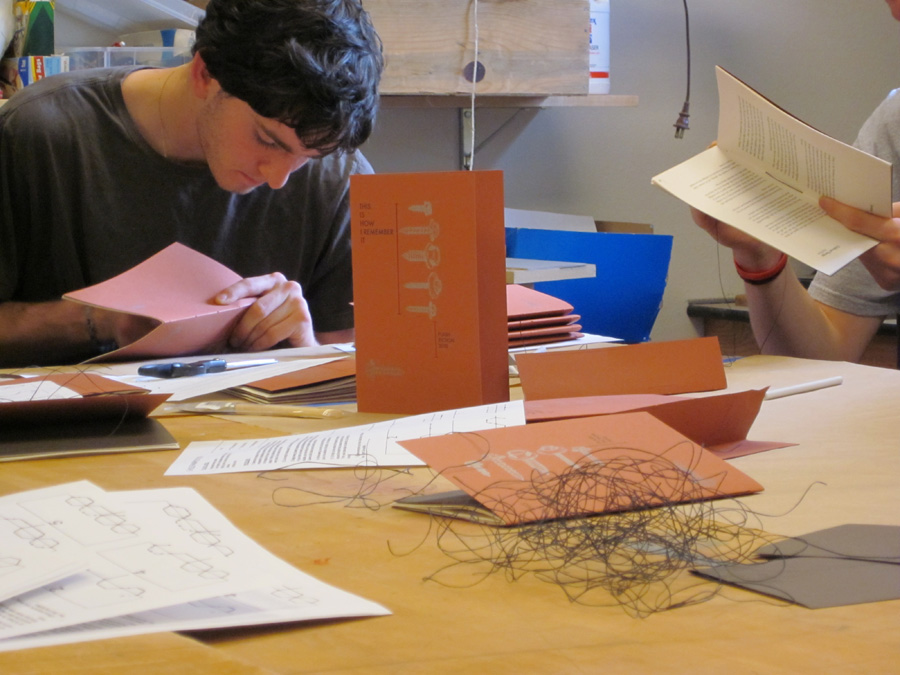
The History & Future of the Book class, which is ending today with a wayzgoose, was taught by librarians Jessy Randall and Steve Lawson. The class, as you might have guessed, dealt with the changing forms and roles of the book in culture, in the past and in our current time. The class also involved this project at The Press. As usual, the students decided the parameters of the project (letting them choose always gives them more ownership of the project and allows for a more significant engagement—they’re not just doing an assignment, but actually making something that they are invested in). They decided on a traditional codex book, but to explore and deconstruct that form by looking at its parts and qualities and researching and writing short texts about those parts. Their meta-text was then placed in the book where the pieces described would usually go. For research, writing, and typesetting the class was divided into pairs (it was a large class—24 students) based on what parts or subjects they were interested in researching. They were given total license as to what their text would be and what information it would contain. As you can see in the book above, some of the texts are straightforward descriptions, while others are poems or “notes” from the book itself. After the text was written, they set it in lead type, and then we printed the book in teams of four, working in shifts over a two day period. Yesterday afternoon we all got together and did the binding as a group.
Because the class was the history and future of the book, we also decided to add a digital component to the project, shown above. So the book exists both as a limited edition letterpress book and as a theoretically infinite edition, readable, shareable, and downloadable ebook.
Enjoy!
Labels:
Class Projects,
History Dept.
Friday, September 16, 2011
BOOK & BOOK STRUCTURE (2)
The first printing project that we did in our Block 7 Book & Book Structure class was a collaborative book involving every student in the class. It covered all of the basics of letterpress printing: page imposition, hand typesetting, locking up & registration, and printing text and images. And of course it had some chance operations driving the whole thing.
To begin, the students were asked to bring in a quote having to do with chance. We shared these quotes as a group and talked about the different aspects of chance that they brought up.
We also gathered a bunch of old image plates that we have at The Press, both random stuff that’s been collected over the years and plates used in older Press publications.
And then the class, using a system loosely devised by Robin and elaborated by them, performed a variety of chance operations in order to determine which quotes and images would be printed on which folios, the position of those elements on the individual pages, and the colors of the images (the text, it was decided, would be black so that it could be printed over the images if need be).
By far our favorite chance procedure was the use of plastic of jumping frogs. You can never go wrong with jumping frogs.
[A brief aside: The textbook for the class was Ellen Lupton’s Thinking With Type: A Critical guide for Designers, Writers, Editors, & Students, 2nd Edition, (New York: Princeton Architectural Press, 2010). You can see its brightly colored cover in the images above. It’s a great book, and it also has a great companion website.]
After the placement of everything was determined, everyone set their type and then we began printing in teams. Printing lasted two classes. The final step was for each student to take two copies of each folio and to make two books, one by simply arranging the pages as they were, and the other by adding new content of their choice. The variety of results in the books that they added to was pretty amazing. Unfortunately, we don’t have any images of those….
Labels:
Art Dept.,
Class Projects,
Press Silliness
Tuesday, September 13, 2011
BOOK & BOOK STRUCTURE (1)
The main event of last school year at The Press was our full class, Book & Book Structure, which was taught by Visiting Professor Robin Price. We bring in a different visiting faculty person every year, and thus the special focus of the class changes slightly every time. The special focus of last year’s class was Robin’s specialty: “chance operations.”
The class is officially an Art Studio, but in true Liberal Arts style, it includes many disciplines that intersect in the making of books: creative writing, literature, history, science, etc.
The class ran during Block 7. A great deal of ground was covered, much more than we actually have documentation of at this point. But we will do what we can. Better to begin at the beginning.
The class began with a get-in-there & get-your-hands-dirty & let-go & see-what-this-stuff-does & see-how-these-things-work exercise. Which is often the best way to start a class: by immediately throwing open the door to exploration.
To begin, each student was given a largish piece of Rives BFK, some india ink, and a variety of implements (brushes, sticks, silverware, etc.). They were told to make marks on the sheet with the ink, either with their eyes closed and/or with their non-dominant hands. After this initial marking (which broke the inevitable hesitancy before the purity of a clean sheet of paper) the students spent some time exploring markmaking with other tools and refining what they had done. After a certain amount of time, they had to stop and pass their sheet to the person next to them.
When they got their new sheet, the students were instructed to tear it in half, and then fold each piece in half to form two folios of an eight page book. Then they were given another medium, a warm, brown ink—“walnut stain” used for calligraphy. During this second phase they were supposed to begin ordering the book in response to the marks already present on the paper (not made by them) and the shape & order of the pages. They did this for a set amount of time and then passed their sheets to the person next to them.
They tore and folded each sheet in half again, in order to make a four folio/16 page book. And then they had to finish their books by bringing some sequence, order, and unity to the initial chaos.
Labels:
Art Dept.,
Class Projects
Monday, September 5, 2011
FLASH FICTION (3)
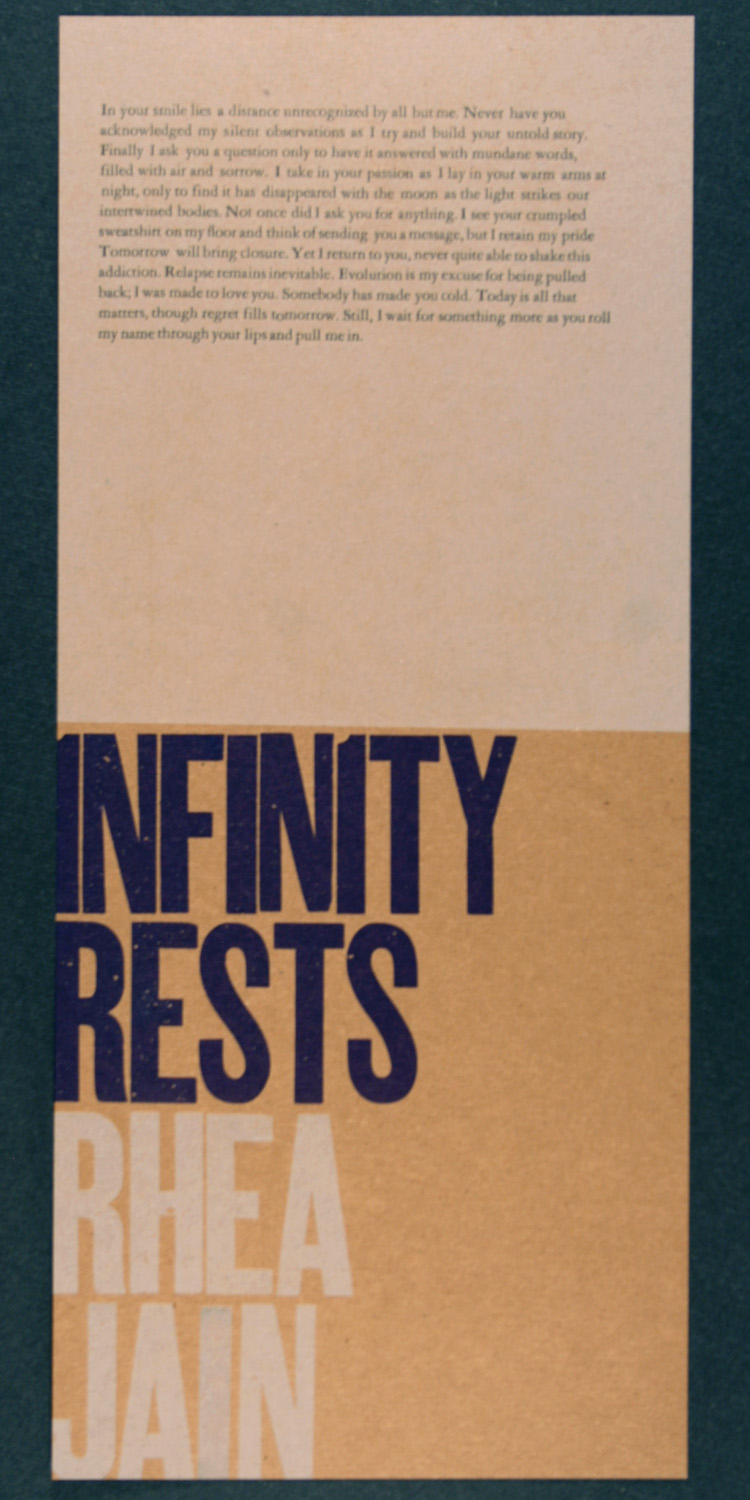
And the broadsides. All of these were printed on chipboard, in 4 colors, out of a combination of lead and wood type, and a photopolymer plate for the white solid. 7” x 16”. Each was made in an edition of 30. The last one, by Charlotte Salley, ended up on Rives BFK, because somehow we ended up short on the chipboard version.
Looking at them together, you can get a sense of how the “modular design” worked. Every piece had a general place, and then we played a bit with the composition on the press. Planned yet improvisational. It all actually went very smoothly—the only real problem we had was some badly damaged type that one or two were set with.
Labels:
Class Projects,
English Dept.,
Ephemera,
Penny Press
FLASH FICTION (2)
And here’s the book. The covers were designed by Eleanor Anderson and were letterpress printed form photopolymer plates. The interior pages were laser printed. The paper was from the French Paper Company. All of the books were pamphlet stitched by hand by the class. We made 100+, so everyone in the class got five, and then the Press had extras.
Labels:
Class Projects,
Eleanor Anderson,
English Dept.,
Penny Press
FLASH FICTION (1)
[Today is the first day of the 2011-2012 academic year here at CC. But I am still catching up on last year’s goings on….]
In Block 4 of last school year The Press worked with Aubrey Hirsch’s Flash Fiction class. Going in, we knew that we were going to make something, but what, exactly, would be up to the students. The Twiction project (see posts below) provided the bar. I personally really enjoyed the very public broadside aspect of that project, so I was thinking along those lines at the beginning. Another thing that made this class special was that one of our Press Deputies, Eleanor Anderson, was in the class, and her presence greatly expanded our Printer Power.
The printers were many, the fiction was extremely short, and our ambition was high, so we went big: 16 individual broadsides plus one book in an edition of 100. A week to print all these? No problem.
To make it all work we came up with a modular design for the broadsides, which would allow us to rapidly switch between different lock-ups, and would also (along with a consistent color scheme) help to unite the individual broadsides as a related group. We decided on doing titles and names in wood type (composed on press) and each student set their piece in lead, in whatever size and face they wanted (but in pre-determined line lengths).
And each student also contributed a different piece of text for the book. They decided on a title and theme and got to writing. Eleanor designed the covers. I did the page layouts, based on the design of the cover. And somehow we kept the whole thing moving and on schedule.
The professor, Aubrey Hirsch, did a broadside and contributed a piece for the book as well.
And when it was all done, the entire class got together in the morning and bound 100+ copies in about 3 and a half hours. Not bad for a group who had never really done any of this before.
And some of them got really into it. This book was made by Neal From.
The one miscalculation that we made in planning this project had to do with the distribution of the broadsides. The original plan was to put them up as a complete set in as many different places on campus as possible. BUT we finished right at the end of Block 4, immediately before winter break. And if we put them up right then, they would have been up for only a day before everyone left, and before they all would have been removed (they clean the public bulletin boards at the end of every block). But we all agreed that, yes, we would put them up first thing in Block 5. And of course that never happened. So much changes over that winter break. But lesson learned: always build distribution time into a project. Or bite the bullet and let them live for just one day. It is ephemera, after all.
Labels:
Class Projects,
English Dept.,
Penny Press
Subscribe to:
Posts (Atom)